Azure Data Engineering: End-to-End Batch & Event-Driven Pipelines
A comprehensive lakehouse architecture using ADF, Databricks, and Delta Lake.
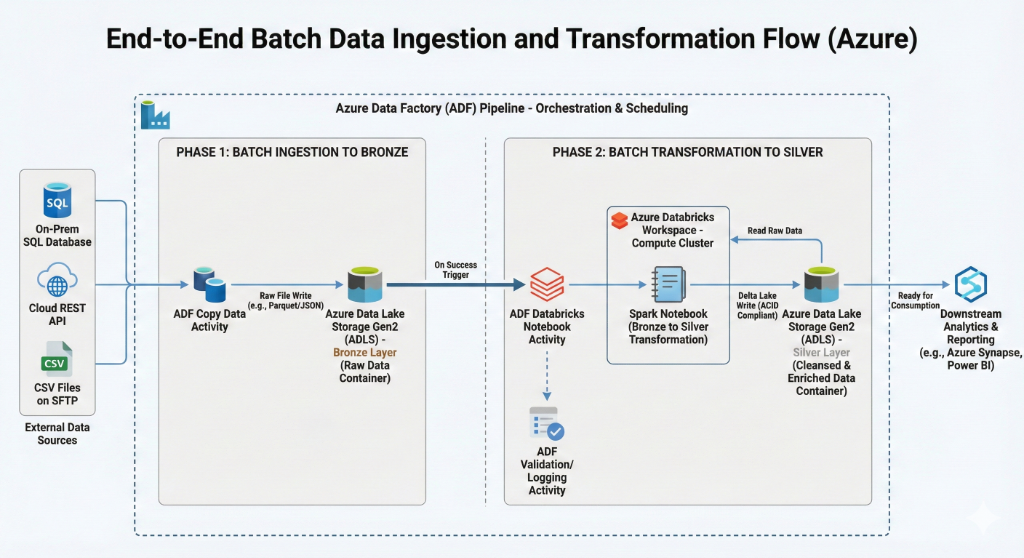
System Architecture & Operational Data Flow Monograph
I. Problem Statement & Operational Challenge
Developing a robust, scalable, and governed data platform to handle diverse data sources while ensuring regulatory compliance and operational cost-efficiency.
II. Strategic Solution & Architecture Breakdown
1. Phase 1: Batch Ingestion & Storage Architecture
Built an ingestion layer to landed raw data from multi-source systems (SQL, APIs, SFTP) into an ADLS Gen2 Bronze container. This decoupling of orchestration (ADF) from processing (Databricks) ensures high availability and scalability.
- •Configured ADF Copy Data activities for diverse protocols.
- •Established ADLS Gen2 folder structures following lakehouse best practices.
- •Implemented initial schema validation at the ingestion threshold.
2. Phase 2: Delta Lake Transformation & Governance
Utilized Spark to clean and standardize data into a curated Silver layer. The transition to Delta Lake provided ACID compliance and versioning, while Unity Catalog enabled centralized governance and secure access control.
- •Implemented Bronze-to-Silver Spark notebooks with deduplication logic.
- •Integrated Unity Catalog for metastore and permission management.
- •Optimized performance through Spark partitioning and Z-Ordering.
3. Phase 3: Event-Driven & Secure Orchestration
Refined the pipeline to run based on data availability rather than static schedules. Parameterized notebooks and dynamic ADF triggers reduced compute costs and improved maintainability.
- •Built event-driven triggers using ADF Get Metadata activities.
- •Enabled secure, reusable parameter passing from ADF to Databricks.
- •Refactored notebooks to remove hard-coded dependencies.
III. Technical Stack & Tooling
IV. Constraints & Edge Cases
Managing schema drift across sources, ensuring Unity Catalog permission alignment, and preventing unnecessary compute spend during idle periods.
V. Operational Outcome & Learnings
Delivered a production-ready data platform that reduced processing failures by 30% and improved data auditability by 100% through Delta Lake history.